Tuesday, September 4, 2018

Irony, nausea alert: Big-highway-boosting Walker attacks big-highway-boosters

Remember Big-Spending and Road-Building King Scott Walker, the one I've written about for years and years and years who never met a road-builder or a fatter interchange or extra freeway lane he didn't love?

Well, Gov. Fewer Lanes with curiously the same name just threw that big spending guy under the bus.
Without providing details, the GOP governor suggested the state could get by with adding fewer lanes when it rebuilds roads. "There are some groups out there that want to spend billions and billions and billions of dollars on more, bigger, wider interchanges across the state," Walker said.
But we see what he's doing, much as he's doing posing as the education governor, or the flood protection governor, since he's they guy who's responsible for hundreds of millions of dollars for more lanes especially on wider interstates across the seven-county SE region, as I've written many times.
-------------------------------------------------------------------------------------
MONDAY, JUNE 22, 2015

Walker motion in 2003 tripped off SE highway overspending

[Updated, 6/22] Outstate Republican legislators still griping about out-of-control highway spending in Southeastern Wisconsin - - check the record in this item reposted from last week: 

Walker led the charge for unsustainable overspending on highways in SE WI that you now don't like.

The Wisconsin Legislature is grappling with a state highway budget unsustainably bloated by reckless borrowing and overspending on the so-called SE 'free'way system - - a problem that has helped stall the entire state budget process while preposterous presidential hopeful Scott Walker keeps skipping out to campaign from Iowa to New Hampshire and beyond.

So it's important to remember that Walker - - as Milwaukee County Executive - - played a key role in 2003 on a SE regional planning commission advisory committee which voted, without a companion financing plan, to recommend to state highway planners that Wisconsin add to the SE 'freeway' system the maximum number of new lanes among the alternatives considered - - 127 miles of lanes instead of 108 - - in what ultimately became a $6.4 billion package.

Walker's motion added an estimated $750 million to the ultimate price tag and also increased the number of structures and land removed from the tax base. 

Though the price tag of the still-incomplete-and-still-unfunded Zoo Interchange has come down from its original projection, other segments of the seven-county system have not begun or may be delayed, further driving up their estimated costs - - all of which are in 2003 dollars.

The regional planning commission - - SEWRPC - - often turns major projects over to advisory committees - - and in this case, the full SEWRPC commission accepted the recommendation and forwarded it to WisDOT, which, in turn, accepted it as the unfolding blueprint for billions in SE WI highway work that continues to be underfunded.

[Update] Following the vote, The Milwaukee County Board passed a resolution opposing the expansion of the freeway system, per Walker's motion, and Walker vetoed it. Fifteen members of the Milwaukee Common Council, nearly its entire membership, sent SEWRPC a letter also opposing the costly expansion and noted Walker's resolution veto.

I attended the advisory committee meeting where Walker made his accepted motion for the full lanes' expansion that added 19 miles of construction cost, and I wrote about it for this blog in June, in 2009: at the highlighted link, begin on page 7 of the advisory committee's report for Walker's motion and comments in the minutes, with the final vote at the end of the committee report.

Also for the record: then-Milwaukee Mayor John Norquist, Milwaukee Common Council President Marvin Pratt and several others voted no. Call them the taxpayers' true friends, unlike Walker, then-Waukesha County Executive Daniel Finley and others, including private sector special interest representatives.

This are the key sentences from the meeting minutes with regard to motions and votes:

Mr. Walker moved to amend the motion such that the final plan would include the provision of additional capacity on 127 miles of the regional freeway system – specifically, adding to the 108 mile recommendation the widening to eight lanes of IH 94 between the Marquette and Zoo Interchanges and of IH 43 between the Mitchell Interchange and Silver Spring Drive, as proposed in the preliminary recommended plan....
Later:
Chairman Drew asked if there was any further discussion or possible amendments to the main motion. There being no further discussion or proposed amendments, Chairman Drew asked for a roll call vote on pages 14-19 of Chapter VII as amended to include the provision of additional capacity on 127 miles of the regional freeway system and to recommend that the WisDOT present to the State Legislature and Governor a financing plan before proceeding to the reconstruction of each freeway segment. On a vote of 15 ayes to 8 nays, pages 14-19 of Chapter VII as amended were approved. Messrs. Buestrin, Cook, Drew, Dwyer, Finley, Kehl, Melvin, Miller, Norem, Sheehy, Speaker, Walker, White, Wirth and Ms. Jacobson voting in favor of pages 14-19 of Chapter VII as amended. Messrs. Fafard, Holloway, Leonard, Millonzi, Norquist, Pratt and Ms. Estness and Ms. McCutcheon voted against pages 14-19 of Chapter VII as amended. Mr. Matzke abstained from the vote. 
------------------------------------------
From my 2009 blog item: 
Remember when the Southeastern Wisconsin Regional Planning Commission spent $1 million of highway planning money to pencil in all this freeway reconstruction and expansion - - $6.4 billion dollars' worth - - but didn't include a financing recommendation to pay for it?
Not our job, the planners said.
But they sent on to WisDOT, which never met a highway plan it wouldn't share eagerly with their true constituents - - the road-builders - - a plan recommending building 127 miles of new lanes and all sorts of purported safety improvements, wider exits and other gee-whiz concrete amenities.
The SEWRPC advisory committee on this plan even overruled the SEWRPC staff and recommended adding 19 miles of new, controversial lanes in Milwaukee County and the City of Milwaukee, even though the additions forced the demolition of an additional eight businesses and 36 homes.
Tax base? Homes and businesses? All expendable. Collateral damage. Highways first, you know.
The prime mover in this extra dollop of multi-million dollar construction excess, and tax base demolition? 
Milwaukee's County Exec and resident faux fiscal conservative - - Scott Walker. You can read his motion and argument in the meeting minutes, here.
 

See flooding off Foxconn site. Heads up, downstream!

Meet Lake Foxconn, or is Lake Foxwoebecon? 

I'd blogged on August 17th and September 1st about whether downstream neighbors and communities have anything to fear if flood-prone Racine County disgorged runoff from the Foxconn site. (full Foxconn archive here)


Here are some screen shots from video posted by the grassroots organization "A Better Mt. Pleasant" with the stormy, September 2nd answer.

And here is a full archive of posts about Foxconn dating to day one last year.

Foxconn will produce more road, transit under-funding, planners predict

Muddy water may soon stop running off the rain-soaked Foxconn site - - video here - - but the flow of red ink the project will spill onto transportation programs and budgets looks to be long-term.

That's because the $4.5 billion in state and local subsidies GOP Gov. Scott Walker stage-managed for the company, and to which he has tied his campaign for a third term, will only expand the region's transportation funding shortfall, non-partisan experts conclude. (Full Foxconn archive, here).

An analysis by the Southeastern Wisconsin Regional Planning Commission, (SEWRPC), in a proposed update to its seven-county master plan, estimates that financing needed for Foxconn-related transit and road upgrades will widen an existing gap between the revenues that are available and the revenues that Foxconn's presence will reasonably require.

You can read the SEWRPC master plan, "VISION 2050," here, plus its proposed amendments, comment procedure, and deadline, and a schedule of six regional public hearings on the amendments SEWRPC begin on September 10, here.

I consider this discussion about the impact of Foxconn on transportation funding, particularly with respect to transit needs getting kicked to the curb to be a major takeaway from the agency's plan amendments; I will get back to these and other issues raised in the draft amendments, particularly with respect to housing and other matters.


But let's start this first cut with the amendments and transportation matters:
page4image2187396464page4image2187396800
EXECUTIVE SUMMARY
UPDATED FINANCIAL ANALYSIS FOR VISION 2050 TRANSPORTATION SYSTEM

When VISION 2050 was initially prepared, the financial analysis identified a funding gap, which required identifying the funded portion of the recommended transportation system. 

This funded portion is referred to as the “Fiscally Constrained Transportation Plan (FCTP)” and is presented in Chapter 2 of Volume III of the VISION 2050 plan report. 

The original FCTP included all transportation elements of VISION 2050 except for portions of the public transit element. Specifically, most of the major transit improvement and expansion components in VISION 2050 were not included in the FCTP, and also reductions in current transit service were expected to continue. 

However, the analysis noted that the recommended arterial system improvements, particularly reconstructing the regional freeway system, would require funding levels from State budgets of the last decade to be maintained.

In revisiting this analysis of existing and reasonably expected costs and revenues associated with the transportation system recommended in VISION 2050, staff confirmed that without additional revenue the Region will not be able to achieve the public transit system recommended in VISION 2050. 

The updated analysis also shows that expected revenues will be insufficient to complete the recommended reconstruction of several portions of the Region’s arterial street and highway system by 2050. 

This will result predominately in a reduction in the amount of freeway that can be reconstructed by 2050, but will also result in a reduction in the amount of surface arterials that can be reconstructed with additional lanes or can be newly constructed by 2050...
----------------------

I don't think anyone as long as Walker is governor and his 'small-government' party is in power will expect new transit financing, so get used to more congestions and air pollution.

UPDATES:

Here is the comment procedures, and public meeting schedule for discussion of the plan amendments:


Public Meeting Schedule
​
Monday, September 10, 5:00-7:00PM
Carroll University - Campus Center (Oak Room)
​
Tuesday, September 11, 5:00-7:00PM
Mitchell Street Library, Milwaukee
​
Monday, September 17, 5:00-7:00PM
SC Johnson iMet Center, Sturtevant
​
Tuesday, September 18 5:00-7:00PM
Villard Square Library, Milwaukee
​
Wednesday, September 19, 5:00-7:00PM
Boys and Girls Club of Kenosha
​
Thursday, September 20, 5:00-7:00PM
Corinne Reid-Owens Transit Center, Racine
​
Submit Comments

Comments can be submitted in person at a public meeting, online through the SEWRPC website, or via email, letter, or fax (contact information at the bottom of this page). Any comments received through September 30, 2018* will be reviewed by Commission staff and will be summarized and addressed. The comments received will be reviewed by the Advisory Committees guiding VISION 2050 and the Commission as part of their consideration of incorporating the Foxconn development into VISION 2050.

Additionally, the amendments will be discussed at the next meeting of the SEWRPC Environmental Justice Task Force:


September 13, 2018 4:30 p.m.
Milwaukee Urban League 435 W. North Avenue Milwaukee, Wisconsin

Monday, September 3, 2018

As one nature preserve sags under floods, another in Sheboygan faces bulldozing

This is a tale of two Wisconsin nature preserves battling for preservation. 

One was damaged from the skies, with little warning and no mechanism to stop it.

The other could soon take place, enabled by multiple public agency approvals and officials' signatures.

Two very similar outcomes with completely points of origin, as different as a demotion derby is from a car crash in a hurricane, or a wildfire caused by a lightning strike compared to one set off by a recklessly-tended campfire.

Begin with the massive damage in recent days to the 550-acre Pheasant Branch Creek nature preserve in western Dane County.

Massive rains have uprooted trees and smashed habitat on flood-scoured land preserved for people and wildlife alike to help the air, water and surroundings remain clean and appealing.

Now consider that much the same thing is planned in a 247-acre nature preserve in Sheboygan for a privately-owned, upscale golf complex - - a project which already has in hand a Wisconsin DNR-approved wetland-fill permit and a Wisconsin natural resources board-approved state park land award, all OK'ed by Walker appointees for one of his substantial donors.

 - - rare dunes are set to be upended and additional wildlife habitat will leveled there.

Along with publicly-owned acreage within the adjoining Kohler Andrae State Park that will be converted into a road, parking and a two-story building for vehicle storage and fertilizer mixing.

What happened in the Dane County preserve was an act of nature, probably enhanced by short-signed political decisions and development that treated wetlands as profit centers, and not as integral elements in a functioning, refreshing environment.

What is on the table for Sheboygan if the developer prevails in court will be brought on by corrosively-careless politicians and developers dismissive of the natural world and their obligations to be its stewards.

I have been reporting on the golf course plan and its opposition by the grassroots organization Friends of the Black River Forest since 2014.

Here is one post with a view of the state park land ticketed for private bulldozing and use,

and another post which included sections of the project's environmental impact statement, which I will also copy out, here.

*  Page 36: Much of the 247-acre Kohler parcel currently includes forested habitat. The golf course design would remove approximately 100 to 120 acres of forested land cover. Forested land and specimen trees will remain as part of the design located predominantly between golf course features. Opening up blocks of forested land will result in greater potential for windthrow and wind damage to the remaining trees.


*  Page 50: The Kohler Property is almost 100 percent contiguous forest. Up to 50 percent of the forest would be removed if the proposed project is constructed. The remaining fragmented forest would provide some habitat during songbird migration. Invasive species management and restoration of native trees and shrubs in invasive removal areas would help control exotic and invasive species in the retained forest. The forest edge along turfgrass and human use areas created from fragmentation of the forest would probably increase the challenge of exotic and invasive species management. 


The edge would likely provide some habitat for species that inhabit transitions between forest and openings. Habitat value would likely be diminished. 


Tree clearing would occur on the Property for each hole, the access road, the clubhouse/parking lot complex, the practice range, the maintenance facility, the restrooms, and the irrigation pond. Tree clearing may also occur in forested areas between tee and fairways to provide lines of sight. Interior forest bird nesting habitat is likely present within and adjacent to the Project boundary and would essentially be eliminated. Wildlife species inhabiting these areas would be permanently impacted by the loss of habitat. 


However, impact to these species is not expected to create a significant effect on regional populations.


*  Page 63: Kohler has stated that the lakeshore and associated dune habitats are essential to the natural and minimalistic golf course design.


Some trees bordering the beach would be removed, allowing longer sight lines between the Project and Lake Michigan. Trees present in dune habitat that is utilized by a rare species may not be able to be removed unless additional authorizations are obtained (i.e., an incidental take permit). Additionally, the number and area of trees removed would have to be reviewed to determine the potential impacts on the beach/dune community. 

*  Pages 69-70:

Summary of Adverse Impacts That Cannot Be Avoided
The site’s nearly 100% forested canopy would be reduced by nearly half. Habitat value will diminish along forest edges near turf grass and human use areas.

Approximately 3.7 acres of wetland would be lost due to filling including impacts to approximately 1.36 acres of Great Lakes ridge and swale wetlands, a wetland type that is considered “imperiled” in Wisconsin. Additional wetland impacts resulting from alterations to wetland hydrology and the influence of increased nutrients could change the wetland type and allow encroachment of invasive species.

Reduction of the forest to 50 percent cover would result in a substantial reduction of available migratory bird stopover habitat on the Kohler Property. Interior forest bird nesting habitat is likely present within and adjacent to the Project boundary and would essentially be eliminated...

Short term adverse impacts that cannot be avoided include approximately two years of construction traffic, noise, and dust. Hikers on the Black River Trail near the Black River would be the Kohler-Andrae patrons most likely to notice construction noise and changed aesthetics...

It is unknown to what extent storm water infiltration and nutrient and pesticide applications to fairways, tees and greens (for either establishment or maintenance) would impact groundwater quality in this permeable soil and shallow water table environment.
-----------------------
More than 100 acres of trees in the nature preserve will be felled - - aerial photos courtesy of Steve Back, here - - 

Sunday, September 2, 2018

In land stewardship/water rights ruling, WI Sup. Ct. wrote warning for flooded times

Before we had the Walker-led Wisconsin state government that began disregarding wetlands on its first day in office - - each acre of which, mind you, can hold a million gallons of water   - - we had a State Supreme Court that understood the big-picture risks that poor planning

and arrogant disregard posed to the Wisconsin environment.

And to the state constitution's public trust guarantee that the government would be the guarantor of the people's rights to water quality, quantity, access and enjoyment themselves.

Here is a DNR web page that references the high court's signature ruling, and yes, this is the same DNR which has evinced hostility to wetland preservation across-the board, whether favoring a sand mining operation, here, or coddling a major golf course developer/Walker donor, here, and whenever or wherever Foxconn wants to be digging or filling, here,

I will also copy out the DNR web page's entire text, since things on the DNR's website, like its climate change material, or a long-standing chart of Wisconsin CAFOs, have had a way of disappearing since since Walker installed and expanded his preferred "chamber of commerce mentality" management there.

Said the Wisconsin Supreme Court, in 1966:
"A little fill here and there may seem to be nothing to become excited about. But one fill, though comparatively inconsequential, may lead to another, and another, and before long a great body may be eaten away until it may no longer exist."  
And the full DNR page:
---------------------------------------------------------------------------------

Waterway protectionThe public trust doctrine

Canoeing
Canoeing

Wisconsin's Waters Belong to Everyone

Wisconsin lakes and rivers are public resources, owned in common by all Wisconsin citizens under the state's Public Trust Doctrine. Based on the state constitution, this doctrine has been further defined by case law and statute. It declares that all navigable waters are "common highways and forever free", and held in trust by the Department of Natural Resources. 


Assures Public Rights in Waters
Wisconsin citizens have pursued legal and legislative action to clarify or change how this body of law is interpreted and implemented.
Watch how their efforts have benefitted all Wisconsinites in this series of videos.
"Champions of the Public Trust" - Part 1 [YouTube VIDEO length: 11:01]
"Champions of the Public Trust" - Part 2 [YouTube VIDEO length: 6:30]
"Champions of the Public Trust" - Part 3 [YouTube VIDEO length: 11:01]
As a result, the public interest, once primarily interpreted to protect public rights to transportation on navigable waters, has been broadened to include protected public rights to water quality and quantity, recreational activities, and scenic beauty.(1) 
All Wisconsin citizens have the right to boat, fish, hunt, ice skate, and swim on navigable waters, as well as enjoy the natural scenic beauty of navigable waters, and enjoy the quality and quantity of water that supports those uses.(2)
Wisconsin law recognizes that owners of lands bordering lakes and rivers - "riparian" owners - hold rights in the water next to their property. These riparian rights include the use of the shoreline, reasonable use of the water, and a right to access the water. However, the Wisconsin State Supreme Court has ruled that when conflicts occur between the rights of riparian owners and public rights, the public's rights are primary and the riparian owner's secondary.(1)
What are Wisconsin's stream and lake access laws?
Wisconsin's Public Trust Doctrine requires the state to intervene to protect public rights in the commercial or recreational use of navigable waters. The DNR, as the state agent charged with this responsibility, can do so through permitting requirements for water projects, through court action to stop nuisances in navigable waters, and through statutes authorizing local zoning ordinances that limit development along navigable waterways.
The court has ruled that DNR staff, when they review projects that could impact Wisconsin lakes and rivers, must consider the cumulative impacts of individual projects in their decisions. "A little fill here and there may seem to be nothing to become excited about. But one fill, though comparatively inconsequential, may lead to another, and another, and before long a great body may be eaten away until it may no longer exist. Our navigable waters are a precious natural heritage, once gone, they disappear forever," wrote the Wisconsin State Supreme Court justices in their opinion resolving Hixon v. PSC.(2)
Sources: (1) Quick, John. 1994. The Public Trust Doctrine in Wisconsin. Wisconsin Environmental Law Journal, Vol. 1, No. 1. 
(2) "Champions of the Public Trust, A History of Water Use in Wisconsin" study guide. 1995. Wisconsin Department of Natural Resources Bureau of Water Regulation and Zoning. Champions of the Public Trust [PDF]
.

Saturday, September 1, 2018

Storms forecast for Racine County where Foxconn is bulldozing, filling

Racine County and downstream might have preferred that Foxconn's bulldozed, formerly-agricultural site (the full story, here)

along with rainfall-absorbing wetlands now available for permit-free filling had stayed as they were, given this National Weather Service forecast for the next week in flood-hammered Wisconsin.

    Hazardous Weather Conditions

    Detailed forecast for

    Racine County

    Tonight
    Showers and thunderstorms likely through around midnight, then chance of light showers and thunderstorms after midnight. Lows in the upper 60s. Southwest winds 5 to 10 mph. Chance of precipitation 70 percent. 
    Sunday
    Partly sunny with a 50 percent chance of light showers and thunderstorms. Highs in the mid 80s. Southwest winds 5 to 15 mph. 
    Sunday Night
    Mostly cloudy with a 50 percent chance of showers and thunderstorms. Lows in the upper 60s. Southwest winds 5 to 10 mph. 
    Labor Day
    Mostly cloudy. Showers and thunderstorms likely in the morning, then chance of light showers and thunderstorms in the afternoon. Highs in the lower 80s. Southwest winds around 5 mph shifting to the southeast in the afternoon. Chance of precipitation 70 percent. 
    Monday Night
    Mostly cloudy through around midnight then becoming partly cloudy. A 40 percent chance of light showers and thunderstorms. Lows in the upper 60s. South winds 5 to 10 mph. 
    Tuesday
    Partly sunny. A 20 percent chance of light showers and thunderstorms in the afternoon. Highs in the upper 80s. 
    Tuesday Night
    Partly cloudy. A 30 percent chance of light showers and thunderstorms after midnight. Lows in the upper 60s. 
    Wednesday
    Mostly cloudy. Chance of light showers and thunderstorms in the morning, then showers and thunderstorms likely in the afternoon. Highs in the lower 80s. Chance of precipitation 60 percent. 
    Wednesday Night
    Mostly cloudy. Showers and thunderstorms likely through around midnight, then chance of showers and thunderstorms after midnight. Lows in the lower 60s. Chance of precipitation 70 percent. 
    Thursday
    Mostly cloudy with a 50 percent chance of showers and thunderstorms. Cooler. Highs in the lower 70s. 
    Thursday Night
    Mostly cloudy with chance of light rain showers and slight chance of thunderstorms. Lows around 60. Chance of precipitation 40 percent. 
    Friday
    Mostly cloudy with chance of light rain showers and slight chance of thunderstorms. Highs in the lower 70s. Chance of precipitation 30 percent. 
    Friday Night
    Mostly cloudy. Lows around 60. 
    Saturday
    Partly sunny with chance of light rain showers and slight chance of thunderstorms. Highs in the mid 70s. Chance of precipitation 30 percent. 

    Groups, activists, local officials can assert statewide water, wetlands leadership

    With more rain storms and flooding in the weekend forecast, it's time for Wisconsinites to throw themselves a lifeline.

    Let's face it; we have an ineffective, disinterested Wisconsin state government that is led by a governor who busies himself with fund-raising, Presidential day-dreaming, big-shot plane rides and little boy spectator sports and snacking.

    While making sure that serious, informed policy-making is hamstrung or deep-sixed by self-defeating, self-inflicted, block-headed cuts to wetland protection, climate change expertise and comprehensive planning for and spending on state-of-the-art infrastructure.

    So others have to step into the costly and dangerous vacuum which Walker has created, and assume the leadership he's forfeited while also throwing Walker, his team and their enablers out of office..

    Now.

    Local governments (when they can catch their breath). grassroots organizations and other groups need to get coordinated, grab flood control, stormwater mitigation and inter-connected scientific issues to take over the planning and the narratives which a disinterested Walker and his donor-compliant and equally-compromised legislative allies have abandoned.

    There are well-positioned, credible, dedicated NGOs in Wisconsin, including GreenFire, Midwest Environmental Advocates, Clean Wisconsin, Wisconsin Wetlands Association, River Alliance of Wisconsin, and Milwaukee Riverkeeper, to name but a few. 

    The Bad River and Menominee tribes know the land, the water and the way to fight polluting, bulldozing mining companies whose motives and actions are all about predation and extraction, not protection or preservation.

    There are numerous grassroots groups which are in the thick of water and wetland issues right now - - Friends of the Black River Forest, A Better Mt. Pleasant, Kewaunee Cares, Friends of the Central Sands, League of Conservation Voters, Wisconsin Wetlands Association, Citizens Organized To Protect Lake Superior Against CAFOs, land trusts, nature preserves and more.

    They have websites, Facebook pages.  and other resources. 

    And the state is full of seasoned and energetic educators, attorneys, architects, engineers, farmers and retirees who will demand for their children and grand-children a state that can better guarantee, or at least establish a priority on dry basements, secure bridges, respectable roads, clean air, uncontaminated rivers and safe drinking water.

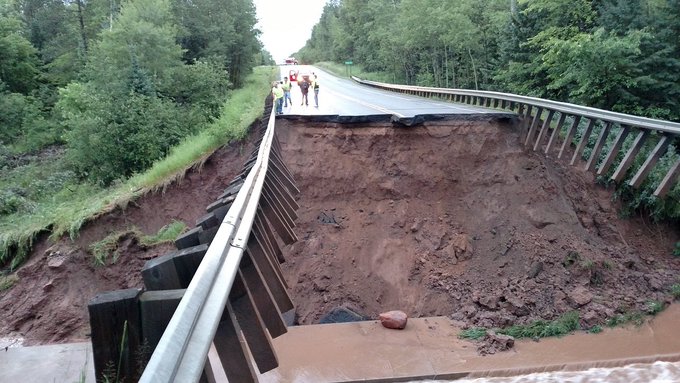
    This year's storms have killed people. 

    The damage is in the scores of millions of dollars, and growing. 

    Accepted science says the climate is changing, the planet is warming, and storms are intensifying, so we should reject a perverse, donor-controlled political science which supports practitioners who want extended terms in office where they intend to maintain a sorry and soggy status quo.

    And just as I didn't offer  a complete list of groups and entities who can fill the void, let me mention just one worthy, functioning model of flood control and wetland preservation.

    Take a look at the Milwaukee Metropolitan Sewage Commission's "GreenSeams" program, and remember, the MMSD services ten counties and works off watershed planning and climate change awareness. I wrote about it last year - - imagine something like this is in your community, up the hill, at the edge of town, and so on:
    I'm sure it hasn't hurt the Milwaukee Metropolitan Sewerage District's multi-county 1,000,000+ residents during the recent heavy rains that its wetlands-and-shoreline natural flood control program known as Greenseams now totals more than 3,400 water-absorbing acres and 100,000 trees planted.
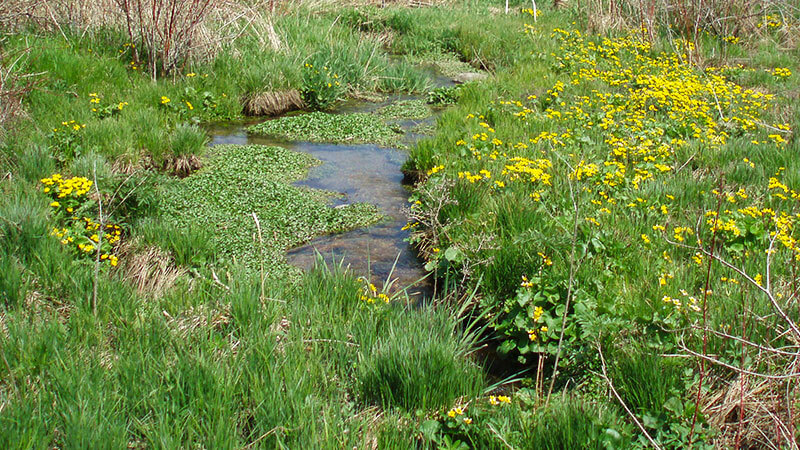
    Water flows from a natural spring on Greenseams® Hoerig property
    And while the Wisconsin Department of Natural Resources is busy scrubbing climate change science from its official website, and other state government agencies drag their feet while Wisconsin gets wetter and warmer, the MMSD acknowledges the realities of climate change and its obligations to adapt, expand Greenseams and boost other elements of green infrastructure to serve the people and save us money, as the agency notes in its current plan goals:
    The Milwaukee Metropolitan Sewerage District’s 2035 Vision and Strategic Objectives
    Integrated Watershed Management Goals:
    a. Support a watershed-based permitting program and water quality trading program that improves environmental performance in a cost effective manner.
    b. Work with MMSD’s partners to strive toward zero basement backups.
    c. Work with MMSD’s partners to achieve, to the extent feasible, zero sanitary sewer overflows and zero combined sewer overflows.
    d. Work with MMSD’s partners to achieve zero homes in the 1% probability floodplain.
    e. Acquire an additional 10,000 acres of river buffers through GreenseamsSM and other regional programs.
    f. Use green infrastructure to capture the first 0.5 inch of rainfall.
    g. Harvest the first 0.25 gallons per square foot of area of rainfall.
    Integrated Watershed Management Initiatives:
    a. MMSD will help municipalities within the District reduce the volume of flows they deliver to MMSD’s sewer system cost effectively. 
    b. Continue to plan, design, construct, and operate MMSD’s grey infrastructure to exceed regulatory and economic requirements.
    c. GreenseamsSM
    1) Expand the boundaries of the GreenseamsSM program to match regional watershed boundaries. 
    2) Designate a percentage of annual GreenseamsSM funding toward improving the rainwater storage capacity of the properties.
    d. Maximize MMSD’s ability to deliver public educational programming to increase the general public’s support and understanding of its operations.
    e. Integrate green infrastructure with MMSD’s grey infrastructure.
    Climate Mitigation & Adaptation Initiatives:
    a. Create and support a robust southeast Wisconsin regional climate change modeling program that will help forecast climate change impacts.
    b. Create an internal risk analysis process that characterizes near-, mid- and long-term actions necessary to protect MMSD’s existing investments in facilities and create new facilities, programs, and operational improvements that adapt to the wet weather impacts of climate change.
    c. Expand green infrastructure to help to mitigate climate change and make the region more resilient in the face of intense storms.