Showing posts sorted by relevance for query Canada. Sort by date Show all posts

Sunday, April 23, 2017

May 1 dairy war deadline looms; whither Trump, Walker, et al?

[Updated] May 1, May Day next Monday is in fact a genuine Mayday! for dozens of modestly-sized dairy farmers in Wisconsin and elsewhere who could lose on that day their regular bulk milk buyer because Canada has begun to protect its home-country dairy business and is cutting back on US imports like those the Wisconsin farmers routinely provided.
File:Confined-animal-feeding-operation.jpg
Trump promised during his Kenosha visit last week that he and "Scott" [Walker] and "Paul" [Ryan] and presumably also Wisconsin-native and White House Chief of Staff Reince Preibus who had a seat on Air Force 1 for the Wisconsin junket would hold some great #MAGA [Make America Great Again] meetings and get things straightened out:
"We're going to get together and we're going to call Canada," Trump said. "And we're going to say, 'What happened?' 
But May 1 is getting awfully close and we see no signs that Canada has realized its mistake and wants to get back in line so our purported Great Deal maker-in-Chief can have the kind of NAFTA he wants without Canada getting in the way or receiving anything in return.

This might have been moved along more quickly if we had a US Ambassador to Canada on the job, or at least-partially staffed State Department, Trade Representative and US Department of Agriculture offices and experts in place, but as Trump told us during his nominating convention, he's the only one that can solve our problems so Wisconsin dairy farmers faced with sending their herds to slaughter May 2nd have to put their faith in our self-declared Maximum Leader.

Update: Other Wisconsin processors may step in, but most of nearly 60 Wisconsin dairy farms facing the May 1 cutoff have yet to find a buyer for their milk.

The problem: oversupply.

And I'm not sure what "Scott's" leverage in all this actually is. The last time we heard Walker open his mouth about Canada it was during the Presidential campaign when he tried to out-trump Trump in the wall-building business by yammering on about putting one across Canada from the Atlantic to the Pacific shores.


This specific fight aside, I'd noted in a recent posting the contradiction about ramped-up milk production in Wisconsin for which there may be no market and Walker's plan to expand dairies and their output in Wisconsin:

Walker in 2012 began financing a state plan to boost milk production in the state:
Walker hopes to grow Badger State milk production to 30 billion pounds annually by 2020. The effort to do that has been dubbed "30x20" and is part of the Grow Wisconsin Dairy program.
Walker unveiled his proposal in Madison on March 13. He chose the twentieth annual business conference of the Professional Dairy Producers of Wisconsin (PDPW) for his announcement.
That plan, of course, principally which benefits his friends in Big Dairy and the environmentally-damaging/pollution-producing/ground-water-sucking/industrial-scale mega feedlots they operate.

I noted an interesting Canadian media piece based on interviews with Wisconsin dairy farmers which I recommend for perspective as May 1 looms and the bigger picture is getting clearer:

'We don't blame you': Wisconsin farmers on Trump's blast at Canada's dairy industry
With a state-wide oversupply of milk, the dairy industry's problems go well beyond a little trade spat

Tuesday, January 17, 2017

On climate, Canada done w/ censorship; whither Trump and WI?

Grim that incoming key Trump senior nominees, like their boss and our soon-to-President have no use for climate change science.

And after I'd shown that the State of Wisconsin's Department of Natural Resources had again scrubbed climate science information and links from its official web pages, the Milwaukee Journal Sentinel found that similar deletions had whitewashed official Wisconsin Public Service Commission web pages.

Smoke stacks from a factory. 
I'd missed the depth of the long official Canadian crackdown on climate change research and publications which gratefully has been sent packing by the forward-thinking Trudeau government, so consider the Canadian experience a cautionary tale and a reason to fight government censorship - - scientific or otherwise - - wherever you find it:
Nine years of censorship
Canadian scientists are now allowed to speak out about their work — and the government policy that had restricted communications...
The crackdown on government scientists in Canada began in 2006, after Stephen Harper of the Conservative Party was elected prime minister. During the nine-year Harper administration, the government placed a priority on boosting the economy, in part by stimulating development and increasing the extraction of resources, such as petroleum from the oil sands in Alberta. 
To speed projects along, the administration eased environmental regulations. And when journalists sought out government scientists to ask about the impacts of such changes, or anything to do with environmental or climate science, they ran into roadblocks.
In fact, Canada now has a cabinet level department of Environment and Climate Change; ironically depressing, isn't it, that while Trump and right-wing GOP and anti-environmental Gov. Scott Walker both claim to be job-creators, the Canadians are going to be providing a far more friendly environment for green research, development and manufacturing, by policy:
About Environment and Climate Change Canada
At Environment and Climate Change Canada (ECCC), our business is protecting the environment, conserving the country's natural heritage, and providing weather and meteorological information to keep Canadians informed and safe.
Environment and Climate Change Canada is building on its accomplishments with the environment through credible science, effective regulations and legislation, successful partnerships, and high-quality service delivery to Canadians.
We support sound environmental decisions. We work to repair the damage of the past, to collect and pass on knowledge, and to develop, implement and enforce policies to prevent future issues. We also work to ensure that Canadians have a safe, clean and sustainable environment today, tomorrow and well into the future.
Environment and Climate Change Canada is a diverse organization where our programs, services, and people lead the way in implementing the Government of Canada’s environmental agenda. We collaborate with our partners at home and abroad, to realize concrete progress on initiatives that will protect the health of our people and our planet.


Friday, October 2, 2020

Oct. 1 measure of WI's dire COVID outbreak: 3,004 new cases vs. Canada's 1,777

The contrast is obviously more shocking because the entire ocean-to-ocean nation of Canada (its COVID case data are here) has about 37.8 million people, while the State of Wisconsin( COVID-19 data here) has just over 5.8 million people, or less than one-sixth Canada's total.

I began noting the imbalance On September 24 when I saw that Wisconsin was outpacing all of Canada in admissions to hospital Intensive Care Units (ICUs).

Canada reports 92 COVID-19 patients currently in intensive care units there, while Wisconsin exceeds that number by more than 50% with 140 [See "Hospital Capabilities" chart]. 

The data for October 1 using the same webpages above show Canada with 126 ICU admissions, Wisconsin with 181. So while the percentage spread fell marginally over a week, the gap in raw numbers between far-less-populated Wisconsin and all of the nation of Canada remains dramatically tilted against Wisconsin. 

And yet, Wisconsins GOP legislative leaders went to court Friday in support of a lawsuit to overturn the Governor Evers' COVID-19 pandemic-controlling masking mandate. 

MADISON - Republican legislative leaders went to court Friday to show support for a lawsuit against Gov. Tony Evers' statewide mask mandate after more than 17,000 people in Wisconsin tested positive in the last week and some hospitals are on the brink of being overwhelmed. 

The move also came the same day President Donald Trump, who does not wear face masks regularly, tested positive for the coronavirus and officials said he would be hospitalized for a few days.

It began two years ago and the power grabbing hasn't stopped since:


Thursday, September 24, 2020

Wisconsin's COVID data are grimmer than Canada's

Here are some stunning measures of how poorly Wisconsin is controlling the COVID-19 pandemic:

Canada - a country closer to Wisconsin than, say, Kansas or Idaho or Virginia or Tennessee - has a population of 37.8 million people that is more than six times Wisconsin's population of 5.85 million.

Yet Canada reports 92 COVID-19 patients currently in intensive care units there, while Wisconsin exceeds that number by more than 50% with 140. 

Call it the tip of the iceberg, as COVID-19 data bases compiled by The New York Times for Wisconsin and Canada reveal more shocking disparities not in Wisconsin's favor

Wisconsin reported 10 COVID-19 deaths on September 23rd while all of Canada reported nine, and Wisconsin had close to 80% more new positive COVID-19 cases on September 23rd, at 1,883, than did Canada on the same day with 1,090.

I don't see the Wisconsin-Canadian COVID-19 caseload imbalance flipping, as the Republican/far-right in Wisconsin is dumping on Gov. Tony Evers' mask-wearing emergency extension and already convinced the State Supreme Court to kill his effort to extend his earlier 'Safer-at-Home' policy.

And unlike Trump, Canadian Prime Minister Justin Trudeau has been wearing a mask in public or when working in close proximity to other people since May. 

That's the way a normal leader would educate the public and help reduce a pandemic's impact, while an abnormal leader who undermines science, won't wear a mask and gathers people together in crowded, raucous rallies has helped push the US COVID-19 death toll past an unimaginable 200,000. 

300,000 by December 31 isn't out of the question - even more if seasonal flu weakens more Americans' immunities - so Wisconsin's COVID-19 case load and death toll are sure to keep growing.

And the New Year will in all likelihood bring WI GOP State Senate Majority Leader Scott Fitzgerald to the Congress where he can peddle his dumb 'masks-optional' ''philosophy' to fellow science-disbelieving House Republicans whose minority status at the Capitol we hope spreads to the Senate and White House.


Tuesday, March 8, 2016

How Canada could slow, block Waukesha's Great Lakes diversion

As a March 14th comment deadline and final decision-making loom, the Wisconsin water expert Jenny Kehl explains that while Canada has only an advisory role to play when assessing whether Waukesha may access Great Lakes water under the terms of a 2008 US/Canada water management compact, a 1920 treaty between the two nations could be brought into play:
Canada will refer back to an ….older treaty from the 1920s about jointly managing the Great Lakes. [It requires] if significant decisions are made about the stewardship of the Great Lakes, both countries would have to agree,” she says. 
Kehl believes if the Great Lakes states approve the diversion, Canada will use the treaty. “They will veto at that point, using that mechanism,” she says. 
Lake-Michigan.svg 
If interested, here is a link to the comment form. 

Sunday, March 26, 2017

Trump's Great Lakes funding dagger gets national attention

Only fools would stop the progress being made saving the Chesapeake Bay watershed and the five Great Lakes, but because that's where Donald Trump is headed The Washington Post is pointing out the scope of the danger:

The Chesapeake Bay watershed’s wide reach
More than 150 major rivers and streams flow into America’s largest estuary with a watershed extending from Virginia into southern New York and throughout six Mid-Atlantic states. More than 17 million people live in the 64,000-square-mile bay watershed. All precipitation and runoff from this watershed drains into the Chesapeake Bay and onward to the Atlantic Ocean...
Working across state and country borders by the Great Lakes
Trump’s budget proposal also cuts the EPA’s Great Lakes Restoration Initiative, which was launched in 2010 to protect and restore the lakes. The Great Lakes region stretches across eights states and affects more than 30 million people in the United States and Canada. The lakes hold 84 percent of all surface freshwater in North America... 
The Great Lakes Water Quality Agreement of 1987 identified 43 geographic areas of concern: 26 in the U.S., 12 in Canada and five shared between the two countries. These were locations suffering environmental degradation as a result of human activity. In 2012, the updated agreement reaffirmed these areas and the effort to restore them.
Always important to remember that Scott Walker, Paul Ryan, Ron Johnson and the rest of the GOP establishment said Trump was the best option for Wisconsin for the next eight years. 
CANADA
Because the lakes were created by glaciers about 14,000 years ago, they do not have traditional watershed with tributaries. Instead, the Great Lakes basin collects water that falls within the immediate area.
ONTARIO
Deer Lake
Sault Ste. Marie
The EPA has defined 43 areas of concern within the United States and Canada, which require special attention to return to an acceptable level of health. Three in the U.S. and four in Canada have been restored to acceptable levels through the Great Lakes Restoration Initiative. 
Traverse City
Green Bay
WISCONSIN
Toronto
Oswego River
White Lake
Saginaw
Syracuse
MIlwaukee
Rochester
Madison
MICHIGAN
NEW
YORK
Buffalo
Grand Rapids
Detroit
Presque Isle Bay
Erie
Chicago
Toledo
INDIANA
Cleveland
ILLINOIS
PENNSYLVANIA
Nutrients from agriculture flow into Lake Erie, causing algae blooms.
100 MILES
OHIO
Pittsburgh


Wednesday, September 18, 2013

Waukesha Water Plan Raising Questions - - Some Old, Some New

There has been an exchange of letters between Waukesha Water Utility General Manager Daniel Duchniak and Thunder Bay, Ontario, Canada Mayor Keith Hobbs.

The subject: Waukesha's draft application (reviewers at the Wisconsin Department of Natural Resources have yet to get Waukesha's final, final, final draft, but that is another issue for another day) for a diversion of Lake Michigan water under the terms of a 2008 US-Canada Great Lakes water management Compact.

Because Waukesha's borders are outside of the Great Lakes basin, the application needs the approval of all eight Great Lakes US states' Governors before any water can flow because Waukesha's application comes in under a Compact section as an exception to the Compact's broad diversion prohibitions.

Thunder Bay's Hobbs, who is also the chair of a US-Canadian regional Mayor's group, the Great Lakes and St. Lawrence Cities Initiative, is raising questions about Waukesha's application and specifically about Waukesha's intention to send water beyond its city limits.

Some of the diverted water is ticketed for neighboring towns which had made no application for diverted water on their own and to date lack certain Compact-related mandated water conservation plans.

Acreage in and near the proposed and expanded water service area - - defined on a map drawn up for Waukesha by staff at an unelected regional planning commission - - is also set to benefit from road expansion - - another sign that Waukesha County is growing.

Canadian provinces bordering the Great Lakes cannot veto an application for a diversion by a community like Waukesha. But the Canadians have an important advisory role when an out-of-basin diversion application like Waukesha's is being considered because the two countries share responsibility for managing the Great Lakes resource under the Compact, now also US and Canadian law.

Canadians have been raising these questions about Waukesha's application, as I noted six months ago:
So concerns expressed publicly by Canadian Ambassador to the United States Gary Doer about Waukesha's languishing application (Waukesha's Common Council approved it three years ago, though efforts to gain a diversion have floated around since 2006) should be taken seriously as the Wisconsin DNR continues to review the application. 
And decides whether to forward it to the Canadians for their advice and to the other seven Great Lakes states which would have to approve it unanimously under the 2008 Compact for the diversion to occur:
During a visit to Milwaukee last week, Canadian ambassador Gary Doer said Canada generally opposes transferring water from one watershed to another, fearing it would hurt water quality, “and today's project may make sense, but 100 of them won't.”
About the Compact and Waukesha's application, I further recommend this recent, excellent summation op-ed by local water rights advocate Atty. Jodi Habush Sinykin:
Bottom line, if we care about the future of our Great Lakes, we must do what we can to protect them; in the present instance, by supporting a stellar review process that will hold the City of Waukesha's diversion application accountable to every standard and requirement of the compact...
And before I post the letters, let me say that Waukesha's intention to send water beyond its city borders has been raising questions since Waukesha water utility officials leaders delivered the proposed diversion application to its city council in the spring of 2010.

Back in 2010, I wrote;
The weakest link in the application - - and what will raise questions all the way from the Town of Waukesha to the City of Milwaukee, and with reviewers and regulators in all the eight Great Lakes states, is Waukesha's plan to send Lake Michigan water into parts of Pewaukee, Genesee and the Town of Waukesha. 
Expanding the current service territory land mass by 80%. 
That expansion - - mapped out and green-lighted by the Southeastern Wisconsin Regional Planning Commission for the Waukesha application administratively, without public review - - plays some role in Waukesha's request for up to 18.5 million gallons of Lake Michigan water daily.... 
Water for growth is not the goal of the Compact. Take it from a Compact expert's superb analysis, here.... 
Waukesha's water-for-expansion goes beyond meeting its own needs. It's an assault on regionalism, and resource sustainability and the core preservationist principle of the Compact. 
It's where the diversion application lacks the most justification and creates the most waves.
Also among the many commentaries on this blog about the application also is this excerpt from a 2012 posting: 
There are innumerable uncertainties about the application's reception in the seven other Great Lakes states, and perhaps in two Canadian provinces which have advisory roles, as do First Nation tribes there. 
Even after after Wisconsin sends the application to the other states - - and who knows if and when that takes place - - any of the states could send it back for fresh answers or a time-consuming do-over. An unambiguous veto by any of the states (not a step available in the provinces) would deny Waukesha the unanimous approvals by all eight Great Lakes states the Compact mandates for such diversions. 
The Great Lakes water expert Peter Annin, brought some time ago to a public meeting in Waukesha by the city, told an assemblage of citizens and officials in the Common Council chambers that they should expect as a given, at least one state to reject the application on its first reading.
And speaking of Annin, his name and his warning cropped again last week in the Waukesha Freeman:
Waukesha Freeman 09/12/2013, Page A04
Panel: Waukesha’s water application will be challenged in federal court 
Barrett says other states will question service area
By Sarah Pryor 
Freeman Staff

MILWAUKEE – Even if the other Great Lakes governors accept that Waukesha needs a new water source, they’ll have big questions about the city’s water service area, and the application will almost certainly be challenged in federal court, predicted three members of a panel at a breakaway session on Waukesha’s quest for Lake Michigan water during the Great Lakes Coalition’s 9th annual Great Lakes Restoration Conference.

Consisting of Milwaukee Mayor Tom Barrett, “Great Lakes Water Wars” author Peter Annin and Milwaukee Riverkeeper Cheryl Nenn, the panel discussed Waukesha’s application for Lake Michigan water in front of a packed room at the Hilton Milwaukee City Center on Wednesday... 
  
The water service area is created by the Southeastern Wisconsin Regional Planning Commission, not Waukesha, but Annin said the larger service area makes Waukesha’s application more vulnerable to a veto by another state than it would have been otherwise.  
“No matter what happens, this is going to get challenged in federal court,” Annin said. 
Now to the letters:

For technical reasons in the blogging tool, I will start with Hobbs' response, then Duchniak's, so in reverse chronological order: [12:45 p.m. Update - - A copying problem with the Duchniak letter has been resolved. The text is below.]


Mr. Daniel Duchniak, General Manager Waukesha Water Utility
115 Delafield Street
Waukesha, Wisconsin 53188-3615

Dear Mr. Duchniak:

August 27, 2013

Thank you for your letter concerning my comments about the proposed Waukesha diversion from the Great Lakes. I am not sure why you were “surprised and disappointed” at my expression of concern about the proposal. 

The mayors in our organization from Canada and the United States take our stewardship responsibilities for the Great Lakes and St. Lawrence very seriously, and your proposed diversion presents some very significant concerns to the entire community around this water resource treasure we share.


We participated actively in the development of the Great Lakes and St. Lawrence Sustainable Water Resources Agreement, and the Compact, and want to make sure it is implemented true to the spirit and the letter of the law. 


With the City of Waukesha not in the Great Lakes basin at all, and Waukesha County barely in the basin, close scrutiny of your proposal is definitely required. 


This is especially so because we understand you intend to provide water out into the far western portions of the County, even farther away from the Lake Michigan shoreline and the basin boundary.


We also understand that there are significant questions about your consideration of alternative sources of water supply, and your projected demand in the future. Those issues will need to be reviewed closely. 


You state that Waukesha will return “100% of the volume of water it withdraws.” That suggests that you aren’t consuming any of the water while you have it, or that you are replacing Great Lakes water with other water that you are returning, both of which raise concerns.


We plan to follow the proceedings closely because, as you said, this will be an important precedent. 


Only time will tell if it is “good” or “bad” precedent.


Sincerely,


Mayor Keith Hobbs, Chair Great Lakes and St. Lawrence

Cities Initiative
Mayor of Thunder Bay, Ontario 

-------------------------------------------------------------------------------


July 11, 2013
Mayor Keith Hobbs, Chair
Great Lakes & St. Lawrence Cities Initiative

Dear Mayor Hobbs:  
We were surprised and disappointed to read your comments to CBC News on behalf of the Great Lakes and St. Lawrence Cities Initiative about Waukesha, Wisconsin’s request for Great Lakes water ( HYPERLINK "http://www.cbc.ca/news/canada/thunder-bay/story/2013/07/11/tby-thunder-bay-mayor-great-lakes-water-protection.html" http://www.cbc.ca/news/canada/thunder-bay/story/2013/07/11/tby-thunder-bay-mayor-great-lakes-water-protection.html).  
We hope that this letter helps clarify some of the issues you raised.  
We are also happy to discuss these issues further.  
It is our understanding that your organization participated in developing and also supported the Great Lakes – St. Lawrence River Basin Sustainable Water Resources Agreement between the Great Lakes provinces and states, as well as the similar Great Lakes Compact (which is federal law in the U.S.).  
Your support for those agreements is not surprising.  The Agreement between the Great Lakes provinces and states bans diversions outside of the Great Lakes Basin with an extremely limited exception within counties partially in the Great Lakes Basin. 
Then the jurisdiction still needs to demonstrate a need for water with no other reasonable alternative.  You raised the question of where do we draw the "line".  The Agreement and Compact have already drawn the "line" at counties along the Basin divide.  They absolutely prohibit water from going to other counties, states or provinces or to other countries.  
The debate and controversy about drawing a "line" and preventing Las Vegas from getting Great Lakes water was resolved several years ago with the adoption of the Agreement and the Compact.  
The Waukesha Application should be judged on its compliance with the Agreement and Compact.  If approved, it would create an important precedent that the Agreement and the Compact are working.  To oppose or deny the application for the reasons you raised is a threat to the ultimate success of the protections provided by the Agreement and Compact.
As the first community in a straddling county to apply for Great Lakes water, Waukesha will set a positive precedent for any future applications.
For instance, the Compact requires that Waukesha returns approximately 85% of the water it withdraws.  Although Waukesha’s daily withdrawal would be only about 1/1 millionth of 1% of the water from the Great Lakes, Waukesha is proposing to exceed the Compact’s requirement and to return 100% of the volume of water it withdraws, resulting in a ZERO change to lake levels.
The State of Wisconsin is also doing an exhaustive analysis of Waukesha’s application through an Environmental Impact Statement, creating yet another positive precedent.
In addition, Waukesha has been a leader in water conservation, creating the first conservation rates, the first toilet rebate program and the first daytime sprinkling ban in Wisconsin, along with public education and other important initiatives. 
Any threat to Great Lakes levels is not from Waukesha’s application.  The threat to the Lakes would be to ignore the Agreement and the Compact. 
Waukesha provides the opportunity to show that this historic cooperation among governments to protect this resource is actually working.  We are confident that when you have an opportunity to review the details of the application, you will see how Waukesha has worked hard to meet the requirements of the Agreement and Compact.
We hope you will support the Agreement and the Compact by endorsing an objective and scientific review of Waukesha’s application under the terms of these historic accords.
Sincerely,
Dan Duchniak, general manager
Waukesha Water Utility 
cc:  GLSLCI members and staff

Tuesday, September 29, 2015

GOP obstructs federal financing, Waukesha firm takes jobs to Canada

[Updated] Turns out there's a new way to kill Bucky's jobs:

Paul Ryan and other right-wing bigs in the Wisconsin and national GOP House caucuses have ideological objections to government financing for businesses long provided by the US Export-Import Bank, so a major GE unit which makes engines in Waukesha has decided to shut down, hit the road and enjoy a better deal in Canada:
General Electric Co (GE.N) said on Monday it will move production of large, gas-powered engines to Canada from Wisconsin, along with 350 jobs, to access export financing no longer available in the United States. 
In its latest salvo aimed at persuading Congress to renew the U.S. Export-Import Bank's charter which expired in June, GE will invest $265 million in a new state-of-the-art manufacturing plant at a Canadian location yet to be determined. 
The facility, to open in about 20 months, can be expanded to provide flexible manufacturing capacity to support other GE businesses, including engines for railroad locomotives, GE said.
In exchange for moving the production from Waukesha, Wisconsin, Export Development Canada will provide financing support for a range of future products, including some still made in the United States... 
Republican Representative James Sensenbrenner, who represents Waukesha and opposes EXIM "in its current form," said in a statement that the move was a "sober reminder of the urgent need to stay competitive in the global marketplace" and called for lower corporate tax rates.
Michigan's former GOP Governor, now a national business spokesman, has called these GOP congressional ideologues "economically illiterate."


Friday, September 2, 2016

US, Canadian officials want Waukesha's water diversion revisited

A word or two about a call from scores of US and Canadian officials across the Great Lakes region for a fresh review of the recently-approved and still-controversial decision by a regional body under a 2008 Great Lakes water management agreement to approve a diversion of Lake Michigan water to the City of Waukesha.
Lansing — A group of mayors is requesting a formal hearing with the organization of Great Lakes governors that approved in June a Wisconsin community’s polarizing bid to draw water from Lake Michigan. 
The Great Lakes and St. Lawrence Cities Initiative filed the hearing request this week. Its director, David Ulrich, said the organization may take legal action if the request is not granted, though it has not yet made that decision.
Lake-Michigan.svg
As with so many facets of the diversion application's drafting - - and redrafting and approval earlier this year - - the outcome of this new appeal is not immediately clear, but let's remember two things as this precedent-setting process continues to unfold:

*  These officials represent millions of constituents, and as an organization, have credibility, standing and access to the kind of money that could be raised for a serious challenge, if that is the goal.


*  This opposition is neither new or unexpected, as the officials made their feelings known about the diversion application and the review process by the eight Great Lakes states earlier this year; I noted what they said at the time:

The Cities Initiative, a group of 122 local government leaders from the United States and Canada representing over 17 million people, is opposed to the water diversion because it does not comply with the Compact in several ways... 
All of these add up to the bad precedent an approval would set when the Compact created a very strictly limited exception for cities and counties on the borders of the Great Lakes and St. Lawrence basin. 
In fact, the officials have been raising these objections for years, as I'd written in 2013:
There has been an exchange of letters between Waukesha Water Utility General Manager Daniel Duchniak and Thunder Bay, Ontario, Canada Mayor Keith Hobbs.
The subject: Waukesha's draft application (reviewers at the Wisconsin Department of Natural Resources have yet to get Waukesha's final, final, final draft, but that is another issue for another day) for a diversion of Lake Michigan water under the terms of a 2008 US-Canada Great Lakes water management Compact...
Thunder Bay's Hobbs, who is also the chair of a US-Canadian regional Mayor's group, the Great Lakes and St. Lawrence Cities Initiative, is raising questions about Waukesha's application and specifically about Waukesha's intention to send water beyond its city limits.
Canadians have been raising these questions about Waukesha's application, as I noted six months ago:
So concerns expressed publicly by Canadian Ambassador to the United States Gary Doer about Waukesha's languishing application (Waukesha's Common Council approved it three years ago, though efforts to gain a diversion have floated around since 2006) should be taken seriously as the Wisconsin DNR continues to review the application...
During a visit to Milwaukee last week, Canadian ambassador Gary Doer said Canada generally opposes transferring water from one watershed to another, fearing it would hurt water quality, “and today's project may make sense, but 100 of them won't.”
While some of the officials' concerns about the reach of the diversion were resolved - - Waukesha is not supposed to send water to neighboring towns, and other Great Lakes states can play a role ensuring that Scott Walker's notoriously-lax Wisconsin Department of Natural Resources in fact holds Waukesha to all of the diversion's conditions - - it's clear that local officials throughout the region, including in Racine, still have concerns about the diverted water's return flow route via the Root River, through Racine's harbor and back into Lake Michigan.

Again, this is not a new concern, as I noted in 2012:

Return-Flow Trouble May Be Root Of Waukesha Water Plan
So: stay tuned: Racine and other local officials are questioning the process, and the outcome and want to be heard. 

Which means Waukesha's diversion approval may not yet be a done deal.

Monday, March 10, 2014

Canadians Talking Water Wars

We've noted here before that Keith Hobbs, the Thunder Bay, Canada Mayor, does not look kindly on Waukesha's pitch to divert Great Lakes water, but others in Canada see the Waukesha diversion as the beginning of something worse:

Mr. Hobbs believes granting Waukesha’s application for access to the lake would set a dangerous precedent and touch off potential water wars. Some news for the mayor: It may be too late. It looks like those wars are coming anyway.
According to Canada’s ambassador to the United States, water is the new oil. In a recent interview, Gary Doer said that by the end of the decade, the pressure on water quality and quantity will be immense. He predicted that water debates and disputes between the two countries will make the clash over the Keystone XL pipeline “look silly” by comparison.
Doer was in Milwaukee last year and I noted he was not too friendly to diversion planning:
So concerns expressed publicly by Canadian Ambassador to the United States Gary Doer about Waukesha's languishing application (Waukesha's Common Council approved it three years ago, though efforts to gain a diversion have floated around since 2006) should be taken seriously as the Wisconsin DNR continues to review the application and decides whether to forward it to the Canadians for their advice and to the other seven Great Lakes states which would have to approve it unanimously under the 2008 Compact for the diversion to occur:
During a visit to Milwaukee last week, Canadian ambassador Gary Doer said Canada generally opposes transferring water from one watershed to another, fearing it would hurt water quality, “and today's project may make sense, but 100 of them won't.”

Monday, March 31, 2014

Oh, Canada. Oh, Wisconsin

The New York Times has outdone itself over the last two days, running a strong op-ed about Canada's demolition of its environment to extract and sell tar sand crude oil, and a separate opinion piece about the proposed GTac open-pit iron ore mine that would wreck the Bad River watershed in Northern Wisconsin.

And it's hard to miss a crucial similarity: in both Canada and Wisconsin - - despite long stewardship histories - - governments have rewritten and weakened laws to enable resource extraction regardless of the consequences to land, water and environmental legacies. 

About the Wisconsin situation, author Dan Kaufman writes:

To facilitate the construction of the mine and the company’s promise of 700 long-term jobs, Gov. Scott Walker signed legislation last year granting GTac astonishing latitude. The new law allows the company to fill in pristine streams and ponds with mine waste. It eliminates a public hearing that had been mandated before the issuing of a permit, which required the company to testify, under oath, that the project had complied with all environmental standards. It allows GTac to pay taxes solely on profit, not on the amount of ore removed, raising the possibility that the communities affected by the mine’s impact on the area’s roads and schools would receive only token compensation.
About the Canadian situation, author Jacques Leslie writes:
After winning an outright parliamentary majority in 2011, Mr. Harper’s Conservative Party passed an omnibus bill that revoked or weakened 70 environmental laws, including protections for rivers and fisheries. As a result, one proposed pipeline, the Northern Gateway, which crosses a thousand rivers and streams between Alberta and the Pacific, no longer risked violating the law. The changes also eliminated federal environmental review requirements for thousands of proposed development projects.
It all comes full circle, as the Koch brothers are major lease holders in the Canadian tar sand territory and they back Scott Walker.

Walker tells Pres. Obama to approve the Keystone XL pipeline and Canadian crude leaks into Lake Michigan.

It's clear that special interests and major corporations are running the show in Wisconsin and Canada, at the expense of land, water and law.


Thursday, November 14, 2019

WI's Great Lakes' diversion record aired unfavorably in Canada

I've noted Wisconsin's repetitive approvals for diversions of Great Lakes water,
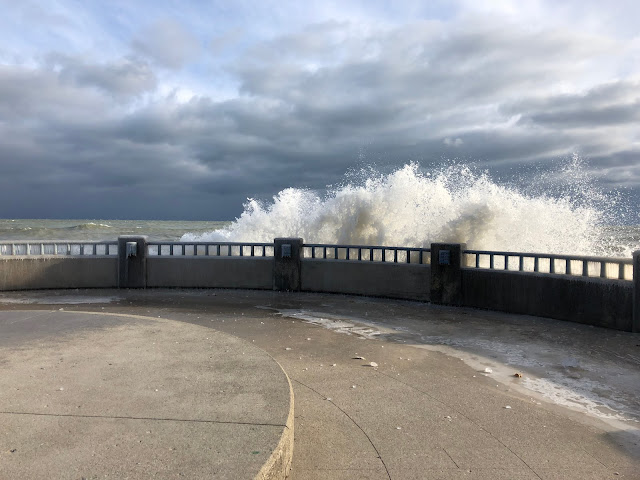
Lake Michigan gale
Milwaukee shoreline, Lake Michigan 
and one Canadian water conservationist's complaints about that has hit media there.
Ontario, Quebec should be represented on IJC water compact
While the complainant does confuse the Waukesha and Racine-for-Foxconn diversion approvals, he's right about a) our state's diversion-happy record, and b) his observation that Canada - - (despite earlier objections) - - has virtually no say in how Great Lakes waters shared with the US can be diverted by US states because the overarching US-Canadian Great Lakes Compact as written assigns Canadian provinces an advisory role only.

And if Canadians don't like this part of Scott Walker's legacy, imagine if he'd gotten to build the US-Canada wall he promoted during his mercifully brief 2015 Presidential campaign flop. 
The Republican presidential candidate Scott Walker said on Sunday that building a wall on the US northern border with Canada was “a legitimate issue for us to look at”.

Thursday, March 21, 2013

Waukesha Diversion Raising Canadian Questions

Signal sent?

Canada and the US share stewardship responsibilities over the Great Lakes, the planet's largest supply of fresh surface water. The resource is managed by international agreements, including a 2008 Compact approved by Wisconsin, seven other Great Lakes states, two Canadian provinces, the Canadian parliament and the US Congress

And while Canadian officials cannot veto Waukesha's application for a Lake Michigan diversion that would travel outside of the boundaries of the Great Lakes basin, our neighbors to the north have a legally-established advisory role on the application's approval.

So concerns expressed publicly by Canadian Ambassador to the United States Gary Doer about Waukesha's languishing application (Waukesha's Common Council approved it three years ago, though efforts to gain a diversion have floated around since 2006) should be taken seriously as the Wisconsin DNR continues to review the application and decides whether to forward it to the Canadians for their advice and to the other seven Great Lakes states which would have to approve it unanimously under the 2008 Compact for the diversion to occur:

During a visit to Milwaukee last week, Canadian ambassador Gary Doer said Canada generally opposes transferring water from one watershed to another, fearing it would hurt water quality, “and today's project may make sense, but 100 of them won't.”
I've lost track of the multiple discussion on this blog about the bigger regional issues facing Waukesha's application than just its reception in, say, Milwaukee or Racine - - and the few minutes devoted to the issue at a recent Waukesha forum show modest awareness of the big picture (relevant text begins at the 8:09 p.m. mark), but here's an example:

Tuesday, July 24, 2012


Waukesha Water Issue Has Broader Audience Than Us Locals

Media in southeastern Wisconsin are replete with coverage of the Waukesha water diversion issue. Laurel Walker of the Journal Sentinel weighs in, for example, here.

And certainly the issue is local, and what we think of as regional:

Can Waukesha find a willing partner to sell it water diverted from Lake Michigan - - Milwaukee, Oak Creek or Racine - - so there is delivery if Waukesha's formal diversion application is approved?

Will the DNR browbeat the Town of Waukesha in to the City's diversion application?

How expensive will the plan become if Milwaukee is not the suppler, and can a negotiation between Milwaukee and Waukesha get started despite conditions Waukesha and the DNR have rejected, at least for now?

But remember that there are other audiences and decision-makers farther away, and they are extremely important in the final analysis - - in fact, can make or break the application.

For Waukesha to receive the diversion, all eight Great Lakes governors must give their approval, and Canadian provincial leaders along with First Nation officials there are permitted input, though not a vote, as the Great Lakes are a shared resource held in trust, with no owner.

This much larger regional review - - beyond the border at 124th St. or the authority of the DNR - - is where critical issues like Waukesha's plan to return the water as treated  wastewater, or Waukesha's interest in sending water beyond its current borders to four smaller municipalities get sticky.

And where the DNR's support for the wider distribution - - hung on the very thin reed of mapping decisions by SEWRPC, an advisory regional planning body run by unelected officials - - could easily raise eyebrows, and worse, in the other states.

The Waukesha application is the precedent-setter under a 2008 statutory Compact, and all the reviewers in the others states, and in Canada, are likely to follow every word and comma in the submission.

And in the DNR's processes and findings, because when the application goes out for the wider review it goes with the DNR seal of approval, too.

A few years ago, the DNR sent out a smaller diversion request on behalf of New Berlin to the other Great Lakes states and Canadian regulators for an informal, courtesy review - - a different set of standards applied - - and some tough comments delayed final approval.

You can read some of that, here and factor that history into what lies ahead as Waukesha and the DNR make decisions that will be vetted by regulatory reviewers from Minnesota to New York to Canada with the power to say "yes" or "no."

And all must say "yes" for Waukesha to move forward.